


What Is a Proof of Concept (PoC)?
Proof of Concept vs. Prototype vs. MVP
People often mix up these three terms. They are related, but each serves a different purpose at a different stage of product development. Here’s a clear breakdown:| Proof of Concept | Prototype | MVP | |
|---|---|---|---|
| Purpose | Test feasibility | Test design and usability | Test market demand |
| Primary Audience | Internal team, stakeholders | Users, stakeholders, designers | Real customers |
| Fidelity Level | Very low | Low to high | Functional product |
| Key Question | Can we build this? | How will this work for users? | Will people pay for this? |
| Typical Output | Report, demo, or small test | Wireframes, clickable mockups | Working product with core features |
| Stage | Earliest | After PoC | After prototype |
When to Use a Proof of Concept
Not every project needs a PoC. But certain situations make it the smartest first step:- Testing a new or unproven technology. If your product depends on a technology your team hasn’t used before, a PoC confirms it works as expected.
- Seeking stakeholder or investor buy-in. A tangible demonstration is far more persuasive than a slide deck.
- Evaluating technical feasibility before committing budget. A PoC costs a fraction of full development and prevents expensive mistakes.
- Exploring a new market or user need. Before building for an unfamiliar audience, test whether your solution actually addresses their problem.
- Integrating with third-party systems or APIs. A PoC can reveal compatibility issues before they become blockers.
- Validating an innovative feature with no precedent. If nothing like it exists, you need proof that it can be built.
Why Is a Proof of Concept Important for Digital Product Development?
A proof of concept does more than test an idea. It protects your team’s time, your company’s budget, and your product’s future. Here are six specific reasons why a PoC matters in digital product development.Reduces Risk and Uncertainty
Every product idea carries risk. Technical risk — can we actually build this? Market risk — does anyone need this? A PoC addresses both by testing the riskiest assumption first. Instead of guessing, your team gets real evidence. That evidence turns uncertainty into a clear yes or no, which is always better than an expensive maybe.Saves Time and Development Costs
According to a CB Insights analysis, 35% of startups fail because there’s no market need for their product. A PoC catches this kind of problem early — before you’ve spent months on development. Fixing a flawed assumption during the PoC stage costs days. Fixing it after launch costs months and potentially the entire project budget.Builds Stakeholder and Investor Confidence
Stakeholders and investors want evidence, not promises. A completed PoC gives them something concrete to evaluate. It shows that the idea isn’t just theoretical — it has been tested and the results support moving forward. This kind of evidence makes funding conversations and approval meetings much smoother.Identifies Technical Challenges Early
API limitations, performance bottlenecks, data compatibility issues — these problems are common in digital product development. A PoC surfaces them before they become expensive to fix. Discovering that your chosen database can’t handle the required query volume is a minor setback during a PoC. Discovering it six months into development is a crisis.Aligns Teams Around a Shared Vision
Product managers, developers, business analysts, and executives often have different mental models of what a product should be. A PoC creates a shared reference point. Everyone can see the same test, review the same results, and agree on the same next steps. This alignment reduces miscommunication and keeps cross-functional teams moving in the same direction.Accelerates the Path to Market
It might seem counterintuitive, but spending time on a PoC actually speeds things up. When your team knows the core idea works, they can move through prototyping, design, and development with confidence. There’s less second-guessing, fewer pivots mid-build, and faster decision-making at every stage. Teams that skip the PoC often end up going slower because they’re constantly revisiting fundamental questions.How to Create a Proof of Concept for a Digital Product
Creating a proof of concept does not require a massive team or budget. These six steps will help you test your digital product idea efficiently.Step 1: Define the Problem and Hypothesis
Start by writing down the specific problem your product solves. Be precise. “Our app helps people save money” is too vague. “Our app automatically rounds up purchases and invests the difference into index funds” is specific enough to test.Then frame your hypothesis: “We believe [this solution] will solve [this problem] for [this audience] because [this reason].” This hypothesis becomes the foundation of your entire PoC. Everything you build and test should connect back to it.Step 2: Set Clear Goals and Success Criteria
Before you build anything, define what success looks like. Your success criteria should be measurable and specific. For example: “The recommendation engine returns relevant results for 80% of test queries” or “The payment API processes a transaction in under 3 seconds.”Without clear criteria, you’ll finish the PoC and still not know whether the idea works. Write your success metrics down and share them with your team before starting.Step 3: Define the Scope
A PoC should test one core assumption. Not five. Not three. One. Scope creep is the most common reason proofs of concept take too long or fail to deliver clear results. Draw a hard boundary around what you’re testing and what you’re not.If your product has multiple risky assumptions, run separate PoCs for each one. Keeping the scope narrow means you get answers faster and with less effort.Step 4: Build a Minimal Solution
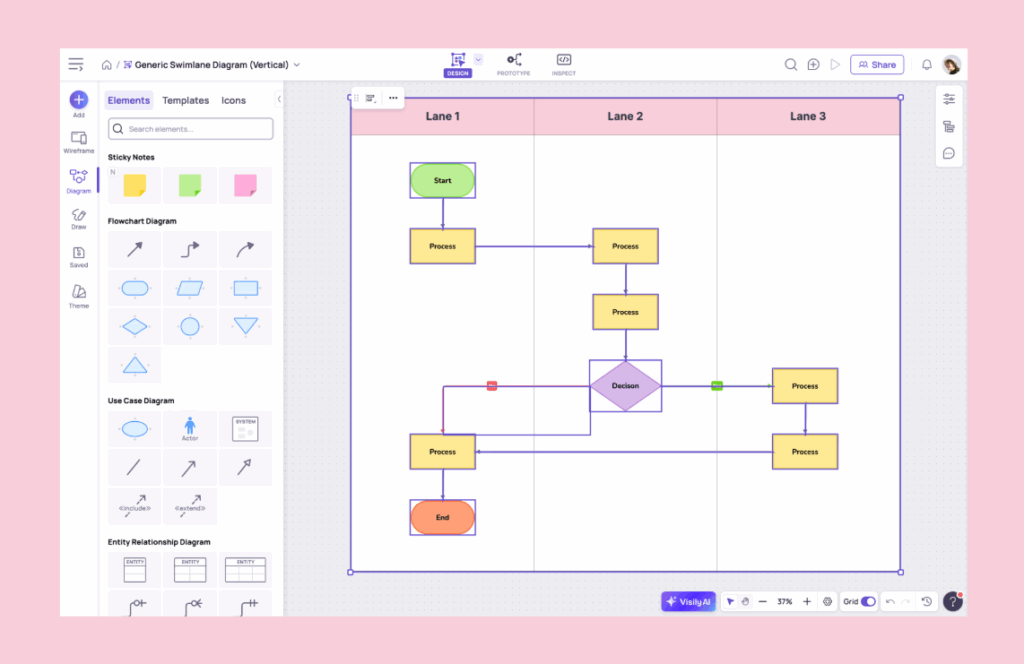
Now build just enough to test your hypothesis. This might be a script, a small application, a data model, or a visual mockup. The key word is minimal. You’re not building a product — you’re building a test.For many digital product PoCs, creating wireframes or visual mockups is a critical part of demonstrating the concept to stakeholders. AI-powered wireframing tools like Visily let teams generate professional wireframes from text descriptions or screenshots in minutes — no design skills required. This makes it easy for product managers and business analysts to show what the product could look like without waiting for a designer.Step 5: Test and Gather Feedback
Present your PoC to stakeholders, subject matter experts, or a small group of target users. Collect structured feedback. Ask specific questions: Does this solve the problem? What’s missing? What concerns do you have?Combine qualitative feedback (opinions, reactions) with quantitative data (performance metrics, success criteria results). Both types of input are valuable for making a well-informed decision.Step 6: Evaluate Results and Decide Next Steps
Compare your results against the success criteria you defined in Step 2. There are three possible outcomes:- Proceed to prototyping. The PoC met your criteria. Move forward with confidence.
- Pivot the approach. The core idea has potential, but the execution needs to change.
- Abandon the idea. The PoC showed the idea isn’t feasible. This is still a win — you saved months of wasted effort.
Proof of Concept Examples in Digital Product Development
Abstract explanations only go so far. Here are four real-world scenarios where a proof of concept makes the difference between smart investment and blind risk.- AI-powered recommendation engine (SaaS). A SaaS company wants to add personalized product recommendations to their platform. Before building the full feature, they create a PoC using a small dataset to test whether their machine learning model can return relevant suggestions at least 75% of the time. The PoC reveals the model needs more training data — saving the team from launching a half-baked feature.
- Secure data transmission (Healthcare). A healthcare startup needs to transmit patient records between two systems using a new API. They build a PoC to test whether the data transfer meets HIPAA compliance requirements and completes within acceptable latency thresholds. The test identifies an encryption bottleneck that would have caused major delays if found later.
- New checkout flow (E-commerce). An e-commerce team hypothesizes that a simplified one-page checkout will reduce cart abandonment. Before developing the feature, they create low-fidelity wireframes of the new flow and test it with a small user group. The wireframes help the team visualize the concept and gather feedback without writing a single line of production code.
- Fraud detection algorithm (Fintech). A fintech company tests a new fraud detection algorithm against historical transaction data. The PoC measures the algorithm’s accuracy rate and false positive rate. Results show the algorithm catches 92% of fraudulent transactions with a 3% false positive rate — strong enough to justify full development.
From Proof of Concept to Prototype: Turning Validated Ideas Into Designs
A successful PoC proves your idea is feasible. But feasibility alone doesn’t get a product built. Stakeholders need to see what the product will look like. Development teams need a visual reference to work from. Users need something they can interact with and react to. That’s where prototyping comes in.The challenge is that many of the people responsible for moving a product forward — product managers, business analysts, startup founders — don’t have formal design training. They know what the product should do, but they struggle to communicate that vision visually. Traditional design tools have steep learning curves that slow everything down.This is where AI-powered design tools are changing the game. They make it possible for anyone to create professional wireframes and interactive prototypes in minutes, regardless of design experience.How Visily Helps You Bring Your Proof of Concept to Life
After your proof of concept confirms your idea works, you need a fast way to turn that validated idea into something visual and shareable. Visily is an AI-powered wireframing and prototyping tool built for exactly this moment. It’s designed for product teams — especially people without design backgrounds — who need to move from concept to clickable prototype quickly.Turn Ideas Into Wireframes With AI
Describe your product idea in plain English, and Visily’s AI wireframe generator creates a professional wireframe in seconds. The Text to UI feature turns written descriptions into visual layouts automatically. You can also use Screenshot to Wireframe — upload a screenshot of any existing app or website, and Visily converts it into an editable wireframe you can customize.Drag-and-Drop Design for Non-Designers
Visily’s canvas works the way you’d expect — drag elements, drop them where you want, resize, and rearrange. The platform includes thousands of pre-built templates and UI components so you don’t have to start from scratch. No design training needed. If you can use a presentation tool, you can use Visily.Build Interactive Prototypes to Wow Stakeholders
Static wireframes are useful. Interactive prototypes are better. Visily lets you add clickable interactions and user flows to your designs, so stakeholders can experience the product — not just look at it. You can create both low-fidelity and high-fidelity wireframes depending on where you are in the process.Collaborate With Your Entire Team in Real Time
Visily brings brainstorming, design, and prototyping into a single workspace. Your entire team can work together in real time — product managers, developers, business analysts, and stakeholders. When you’re ready for development handoff, export your designs directly to Figma. And the best part: Visily offers a generous free plan with no restrictions on premium features or AI models.Proof of Concept Best Practices and Tips
A PoC is only as good as its execution. These best practices will help you get clear, actionable results:- Keep the scope narrow and focused. Test one assumption per PoC. Resist the urge to test everything at once.
- Set a strict timeline. Most PoCs should take one to four weeks. If it’s taking longer, your scope is probably too broad.
- Define success criteria before you start. Deciding what “success” means after the test introduces bias. Set your metrics upfront.
- Involve stakeholders early. Get input from decision-makers before you build. Their buy-in matters, and their feedback shapes a better test.
- Document everything. Record your hypothesis, methods, results, and decisions. This documentation becomes valuable for future projects and stakeholder reviews.
- Use visual tools to communicate your concept. A wireframe or mockup makes your PoC tangible. Tools like Visily help you create visuals quickly, even without design experience.
- Be prepared to pivot or kill the idea. The whole point of a PoC is to learn. If the results say “no,” that’s a successful outcome — you just saved your team from a bigger failure.
Common Proof of Concept Mistakes to Avoid
Even well-intentioned PoCs can go wrong. Watch out for these common pitfalls:- Making the scope too broad. Trying to test multiple assumptions at once muddies the results. You won’t know which variable caused the outcome. Keep it focused.
- Not defining clear success criteria. Without measurable benchmarks, your team will argue about whether the PoC “worked.” Define success before you start building.
- Treating the PoC as a prototype or MVP. A PoC tests feasibility. It’s not supposed to look polished or serve real users. Don’t let it grow into something it’s not meant to be.
- Ignoring stakeholder feedback. If you don’t involve stakeholders in the process, they may reject the results — even if the data supports your hypothesis. According to the Project Management Institute, poor stakeholder engagement is a leading cause of project failure.
- Letting the PoC drag on too long. A PoC that takes three months has become a development project. Set a deadline and stick to it.
- Falling in love with the idea and ignoring negative results. Confirmation bias is real. If the data says the idea doesn’t work, accept it. A failed PoC is cheaper than a failed product.
Start Turning Your Proof of Concept Into Reality
A proof of concept is one of the smartest investments a product team can make. It reduces risk, saves resources, aligns teams, and gives stakeholders the evidence they need to say yes. Whether you’re testing a new technology, pitching to investors, or exploring a product idea, a well-executed PoC sets the foundation for everything that follows.Once your PoC succeeds, the next move is turning that validated idea into something people can see and interact with. Wireframes and prototypes bridge the gap between “this idea works” and “this is what the product will look like.”Visily makes this transition effortless. With AI-powered wireframe generation, drag-and-drop design, and real-time collaboration, anyone on your team can create professional prototypes — no design skills required.Frequently Asked Questions About Proof of Concept
A proof of concept is a small test that shows whether an idea can actually work. It focuses on feasibility — not on building a finished product. Teams use it to check their riskiest assumption before investing significant time or money.
Most proofs of concept take between one and four weeks. The timeline depends on the complexity of the idea and the resources available. Keeping the scope narrow helps teams finish faster. If your PoC is taking longer than a month, the scope is likely too broad.
A proof of concept tests whether an idea is feasible in a controlled environment. A pilot tests whether a validated solution works in a real-world setting with actual users. The PoC comes first. The pilot comes later, after the concept has been proven and a working version has been built.
Product managers, business analysts, or technical leads typically own the proof of concept process. However, cross-functional collaboration is important. Developers, designers, and stakeholders should all contribute their expertise. The product manager's role often includes coordinating the PoC effort and presenting results to leadership.
The cost varies widely based on complexity. Simple PoCs using wireframing tools or no-code platforms can cost very little — sometimes nothing if you use free tools. More complex technical PoCs involving custom development may require a larger budget. The key is to invest just enough to test the core assumption, not to build a full product.
After a successful proof of concept, the next step is typically building a prototype — a visual, interactive representation of the product. Prototypes help teams refine the user experience and gather more detailed feedback from users and stakeholders. Tools like Visily make it easy to go from a validated concept to a professional wireframe or interactive prototype in minutes, even without design experience.