


Product teams talk about user flows and user journeys all the time. Most use the terms interchangeably. That creates real problems during design and development.
A user flow is a diagram that maps the specific screens and steps a user takes to complete a single task inside a product. A user journey is a broader visualization that captures the full experience a user has with a product or brand across every touchpoint, channel, and emotional state over time.
The confusion between these two concepts leads to incomplete design thinking. Teams either obsess over individual screens without understanding how users feel, or they map high-level experiences without building actionable screen-level detail. Both gaps result in wasted design cycles, misaligned stakeholder expectations, and prototypes that miss real user needs.
In this guide, we break down user flow vs user journey, explain what each one maps, clarify when to use them, and show how AI-powered tools help non-designers create both without a steep learning curve.
What Is a User Flow?
A user flow is a visual diagram that maps the exact sequence of screens, steps, and decision points a user follows to complete a specific task within a digital product. It focuses entirely on what happens inside the product.
Think of a simple example. A user lands on a homepage, clicks “Sign Up,” enters their email and password, confirms their account through a verification email, and arrives at a dashboard. That sequence of screens and actions is a user flow.
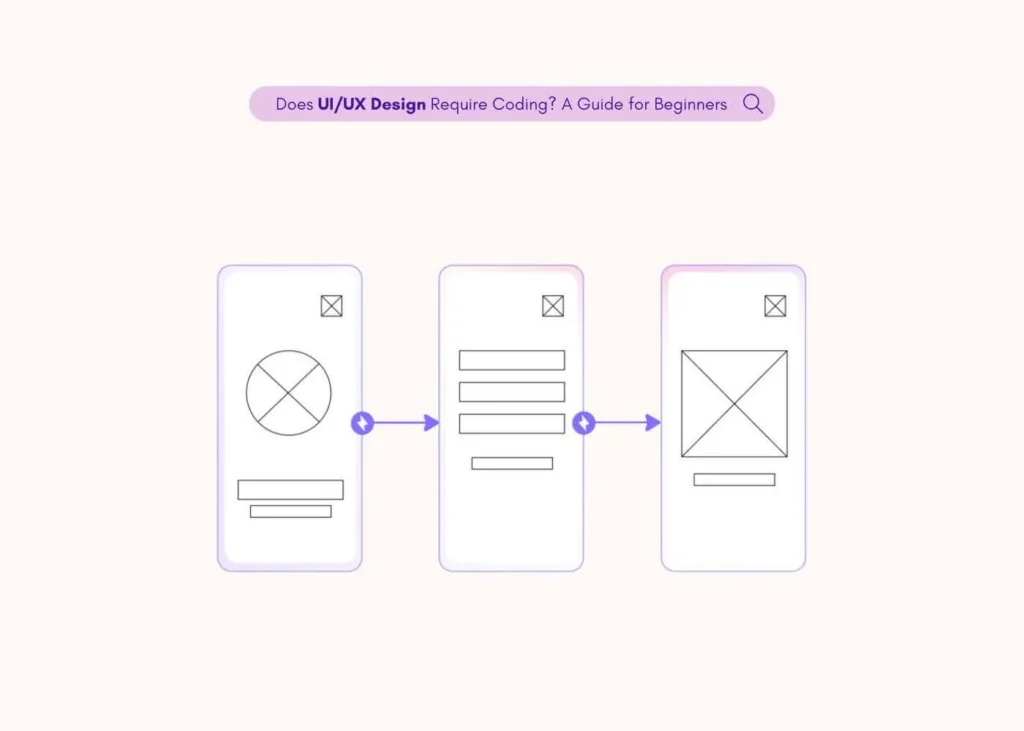
User flows are typically created as flowcharts or wireframe sequences. They answer one core question: can the user get from point A to point B efficiently?
Product managers, developers, and designers all rely on user flows to align on interaction logic before any code gets written.
Key Elements of a User Flow
Every user flow shares a common set of structural elements. Understanding these elements helps teams build flows that are clear and actionable.
- Entry point: The starting location. This could be a homepage, a push notification, or a deep link from an email campaign.
- Screens and pages: Each distinct view the user encounters during the task. A checkout flow might include a cart page, a shipping form, a payment form, and an order confirmation page.
- User actions: What the user does on each screen. Actions include tapping buttons, filling out forms, selecting options, or scrolling.
- Decision points: Moments where the user chooses between two or more paths. For example, a user might choose “Continue as guest” or “Create an account” during checkout.
- System responses: What the product does in reaction to user actions. This includes success messages, error states, redirects, and loading indicators.
- End state: The final screen or outcome that signals task completion. A successful end state might be an order confirmation page or a welcome screen after onboarding.
These elements form the building blocks of any user flow diagram, whether it is a rough sketch on paper or a polished digital wireframe.
What Is a User Journey?
A user journey is a visualization that captures the complete end-to-end experience a user has with a product or brand across all touchpoints, channels, and emotional states. It goes far beyond what happens on a single screen.
Here is a real-world example. A user sees a social media ad for a project management app. They visit the website and read the features page. A week later, they search for reviews on Google. They sign up for a free trial. During the first week, they feel confused by the onboarding process. They contact customer support. After getting help, they start using the app daily. A month later, they upgrade to a paid plan and recommend the app to a colleague.
That entire arc, from first ad impression to paid conversion and referral, is a user journey.
Unlike a user flow, which focuses on screens within a product, a user journey captures the full relationship between a user and a brand over time. User journeys often incorporate emotional data, including what users think, feel, say, and do at each stage. This is where techniques like empathy mapping become valuable, helping teams document the psychological experience alongside the behavioral one.
Key Elements of a User Journey
A user journey map is built from several interconnected elements. Each one adds a layer of understanding about the user’s experience.
- User persona: A specific, research-based profile of the target user. The journey should represent one persona at a time to keep insights focused.
- Journey stages: The major phases a user moves through. Common stages include awareness (learning the product exists), consideration (evaluating options), decision (choosing to sign up or buy), onboarding (getting started), and retention (continued use over time).
- Touchpoints: Every moment of interaction between the user and the brand. A touchpoint might be a Google search result, a customer support chat, an email notification, or an in-app onboarding screen.
- Channels: The platforms or mediums where touchpoints occur. A single journey might span Instagram, Google Search, the company website, email, and the product itself.
- Emotions and thoughts: What the user feels and thinks at each stage. This is where empathy mapping plays a direct role, helping teams document the “Says,” “Does,” “Thinks,” and “Feels” dimensions of user experience.
- Pain points: Specific moments of friction, confusion, or frustration. Identifying pain points is often the most actionable output of a journey map.
- Opportunities: Areas where the team can improve the experience based on identified pain points and emotional patterns.
These elements work together to give product teams a full picture of the user’s experience, not just the screens they click through.
User Flow vs User Journey: Key Differences
Now that both concepts are defined, here are the key differences between a user flow and a user journey.
| Dimension | User Flow | User Journey |
| Scope | Task-level, focused on a single interaction | Experience-level, spanning the entire user lifecycle |
| Focus | Screens, clicks, and navigation paths | Emotions, touchpoints, and channels |
| Timeframe | A single session or task (minutes) | The full relationship with a brand (days, weeks, months) |
| Visual format | Flowchart or wireframe sequence | Journey map or timeline with emotional layers |
| Primary creators | UX designers, developers, product managers | Product strategists, researchers, business analysts |
| Level of detail | Granular, screen-by-screen | High-level, stage-by-stage |
| Output | Wireframes, prototypes, interaction specs | Journey maps, empathy maps, strategy documents |
The difference in scope is the most important distinction. A user flow for an e-commerce app might map the five screens from product page to order confirmation. The user journey for the same app would start weeks earlier, when the user first saw an Instagram ad, and extend weeks later, when they receive a follow-up email asking for a review.
The difference in focus matters just as much. A user flow asks: “Can the user complete checkout in under three clicks?” A user journey asks: “Does the user feel confident and supported throughout their entire buying experience?”
According to research published by the Interaction Design Foundation, effective product development requires understanding both the micro-interactions within a product and the macro-experience across all user touchpoints. Teams that focus on only one perspective tend to build products that work technically but fail emotionally, or products that promise a great experience but frustrate users at the screen level.
Neither tool is better than the other. They serve different purposes at different stages of product development.
When to Use a User Flow vs a User Journey
Knowing the difference matters. Knowing when to use each one matters more.
When to Use a User Flow
Use a user flow when you need to design or optimize a specific task-based interaction inside your product.
- A product manager planning a new onboarding sequence needs a user flow to map every screen from sign-up to first value moment.
- A developer preparing to build a checkout process needs a user flow to understand the screen-by-screen logic, decision branches, and error states before writing code.
- A startup founder prototyping a sign-up experience for investor demos needs a user flow to show exactly how users will move through the product.
- A UX designer optimizing a feature with high drop-off rates needs a user flow to identify where users abandon the task and why.
- A business analyst documenting requirements for a new feature needs a user flow to communicate interaction logic to the development team.
When to Use a User Journey
Use a user journey when you need to understand the full experience across all touchpoints and align your team on product strategy.
- A startup founder pitching to investors needs a user journey to show the complete vision of how users will discover, adopt, and grow with the product.
- A product manager aligning cross-functional teams needs a user journey to create shared understanding of the user’s experience across marketing, design, engineering, and support.
- A business analyst synthesizing user research findings needs a user journey to organize interview data, survey results, and behavioral observations into a coherent narrative.
- A product strategist identifying pain points across the customer lifecycle needs a user journey to spot gaps between what users expect and what they actually experience.
- A team planning a major new product or feature from scratch needs a user journey to map the full experience before diving into screen-level design.
Can You Use Both Together?
Yes. Most effective product teams use both. The user journey sets the strategic context. User flows fill in the interaction-level detail.
Here is how they work together in practice. A user journey might reveal that users feel frustrated during the onboarding stage. That insight tells the team where to focus. A user flow then maps the exact onboarding screens to identify where friction occurs, whether it is a confusing form, a missing progress indicator, or too many steps before the user reaches their first success moment.
The journey tells you what to fix. The flow tells you how to fix it.
AI-powered design tools make it practical for non-designers to create both artifacts without needing a dedicated design team. Teams can generate journey-level diagrams from text descriptions and then build screen-level wireframes from sketches or plain language prompts. This means product managers, founders, and business analysts can produce both strategic and tactical design outputs on their own, in minutes rather than days.
Yes, absolutely. Here is the merged section that covers both user flow and user journey map creation in Visily under a single heading:
How to Create a User Flow in Visily
You do not need design experience to build a user flow or a user journey map. Visily provides dedicated templates for both, along with AI features that speed up the entire process. Here is how to create each one, step by step.
Visily’s User Flow Template is a flexible blueprint that visualizes how users navigate your website or app. The template is fully customizable, ensuring a perfect fit for your design. Follow these steps to build one.
1. Get started with the template. Click “Use this Template” on the user flow template page. You will be taken directly to the Visily design canvas with the template preloaded and ready to edit.
2. Create a free account. Sign up for a free Visily account to access full customization tools. You will be seamlessly brought to the design canvas with the template ready.
3. Define the user’s goal and entry point. Before editing the template, clarify the specific task your user needs to complete. Is it signing up for an account? Completing a purchase? Resetting a password? The first step in creating a user flow diagram is to clarify the objectives, as both the business and the users’ objectives must be clear.
4. Map out screens, decision points, and actions. Use the components and templates library to build your design. On your canvas, use arrows to connect your wireframe screens to various diagram shapes. These shapes represent the user’s navigation path and decision points. Add notes to explain user actions, system responses, and decision points at each step.
5. Customize the design. Tailor the template with easy drag-and-drop tools for a personalized result. Visily supports theme-level updates, so changing fonts, colors, or button styles applies across all screens in a flow. This keeps your design consistent without manual adjustments on every screen.
6. Use AI to speed things up. Visily’s AI features let you add screens, revise layouts, or even suggest next steps based on your flow logic. You do not need to manually build every element. You can also start from scratch using the Text to Design feature by describing your flow in plain language, or use Sketch to Design to convert a hand-drawn sketch into a clean digital wireframe.
7. Collaborate and refine. Invite your team to edit and update the flowchart in real time, ensuring everyone stays on the same page. Share the flow with stakeholders, gather feedback, and iterate until the path is clear and efficient.
With Visily, you can combine the visual layout of a wireframe with the directional flow of a flowchart. This means your user flow is not just a static diagram. It becomes a working design artifact that your team can build from.
How to Create a User Journey Map in Visily
Building a user journey map covers a broader scope than a user flow. It captures the full experience across stages, touchpoints, and emotions. Visily’s User Journey Map Template lets you instantly create insightful user journey maps, helping you understand customer experiences, identify pain points, and reveal areas for improvement.
1. Get started with the template. Click “Use this Template” on the user journey map template page to instantly access the pre-built template. The journey mapping framework is already laid out for you.
2. Create a free account. Sign up for a free Visily account to access complete editing features. Creating an account is free forever.
3. Start from the template or a blank canvas. Begin with a blank canvas on Visily to freely sketch your initial ideas for the customer journey, or choose from Visily’s library of customer journey map templates. These pre-made designs save you significant time because they come with the basic journey mapping framework already laid out.
4. Customize your journey map. One of the most useful features of Visily is the ability to customize your user journey map. With just a few clicks, you can add different components to highlight key touchpoints, pain points, or insights. Here is what you can do:
- Add sticky notes to call attention to pain points that need addressing, with text summarizing the issue or opportunity
- Annotate different steps in the journey with arrows, boxes, or lines to help visualize relationships between touchpoints
- Color-code parts of the map for clarity
- Insert mockups of UI elements to represent the different interfaces a customer encounters, which further contextualizes the journey in a concrete way
5. Add emotional and motivational data. A journey map without emotional context is just a list of steps. This is where empathy mapping becomes valuable. Visily’s User Empathy Map Template helps you capture what users say, do, think, and feel at each stage. Use insights from user interviews, surveys, and support tickets to fill in these layers.
6. Collaborate with your team. Visily offers the ability to share your user journey map and collaborate with team members and stakeholders. Within the platform, you can invite others to view, edit, and comment on your map. Your team’s comments and annotations will allow you to gather diverse perspectives. You may gain valuable insights into pain points you may have overlooked.
7. Use AI to generate journey diagrams from text. Visily’s Text to Diagram feature lets you quickly generate a user journey map, customize it to your needs, and save a significant amount of time. Describe your user’s journey stages in plain language, and the AI produces an initial diagram you can refine. The template is adaptable and aligns precisely with your unique user flows.
Whether you are mapping a specific sign-up task or analyzing an entire customer lifecycle, Visily gives you the structure and flexibility to build both user flows and journey maps that your entire team can use as a shared reference.
Common Mistakes When Mapping User Flows and Journeys
Even experienced product teams make avoidable errors when creating user flows and journey maps. Here are six common mistakes and how to avoid them.
- Confusing user flows with user journeys. This is the most frequent mistake. A team creates a user flow when they actually need a journey map, or vice versa. Before starting, ask: “Am I mapping a specific task inside the product, or the full experience across all touchpoints?” The answer determines which tool to use.
- Making user flows too detailed or too vague. A flow that includes every possible micro-interaction becomes unreadable. A flow that skips key screens becomes useless. Aim for the right level of detail by focusing on the screens and decisions that matter most for the specific task.
- Ignoring emotional data in user journey maps. A journey map without emotions is just a list of touchpoints. The real value comes from understanding how users feel at each stage. Use empathy mapping techniques to capture the emotional layer.
- Not involving stakeholders in the mapping process. Flows and journey maps created in isolation often miss critical context. Include team members from product, engineering, marketing, and support to get a complete picture.
- Creating maps once and never updating them. User behavior changes over time. Products evolve. A journey map from six months ago may no longer reflect reality. Schedule regular reviews and updates.
- Relying on assumptions instead of user research. The biggest risk is building flows and journeys based on what you think users do rather than what they actually do. Ground your maps in real data from user interviews, analytics, surveys, and usability tests. Research from the American Psychological Association on cognitive bias in decision-making shows that teams consistently overestimate how well they understand their users without direct research.
Frequently Asked Questions
Is a user flow the same as a user journey?
No. A user flow maps the specific screens and steps within a product for a single task. A user journey maps the entire experience across all touchpoints and emotional states over time. They serve different purposes but work well together.
What comes first, user flow or user journey?
Typically, the user journey comes first. It provides the strategic big picture of the user’s experience across all stages. User flows are then created for specific interactions within each journey stage. However, some teams start with user flows for immediate design needs and build the journey map later as the product matures.
Do product managers need to create user flows?
Yes. Product managers use user flows to communicate product requirements, align teams on interaction logic, and test ideas before development begins. AI-powered design tools make it easy for product managers to create user flows without any design training.
Can you create a user flow without a designer?
Yes. Modern AI-powered platforms are built specifically for non-designers. You can describe a flow in plain language, upload a hand-drawn sketch, or start from a pre-built template to create professional user flows in minutes. No design training is required.
What is the difference between a user flow and a wireframe?
A user flow is a diagram showing the sequence of steps and decisions a user takes to complete a task. A wireframe is a visual layout of a single screen showing where elements like buttons, text, and images are placed. User flows show the path between screens. Wireframes show what each individual screen looks like.
What is the difference between a user journey and a customer journey?
The terms are often used interchangeably. “User journey” is more common in UX and product design contexts, focusing on the experience of using a product. “Customer journey” is more common in marketing and sales contexts, focusing on the buying experience. Both map touchpoints, emotions, and stages across the full lifecycle.
Final Thoughts
User flows map task-level interactions within a product. User journeys map the full experience across touchpoints and emotions. Both are essential for building products that work well and feel right to the people using them.
For non-designers, including product managers, founders, developers, and business analysts, the challenge has always been creating these artifacts without design expertise. AI-powered tools have removed that barrier, making it possible for anyone on a product team to produce professional flows, wireframes, journey diagrams, and empathy maps.
Visily makes it easy to create all of these from a single platform. Start for free and go from idea to interactive prototype in minutes.